Architectural Wonder—A Millennium Monument Standing Atop Snake Hill
The Yellow Crane Tower is a three-dimensional epic that embodies the wisdom and ingenuity of generations of craftsmen.Climbing the main tower is the core experience for every visitor.
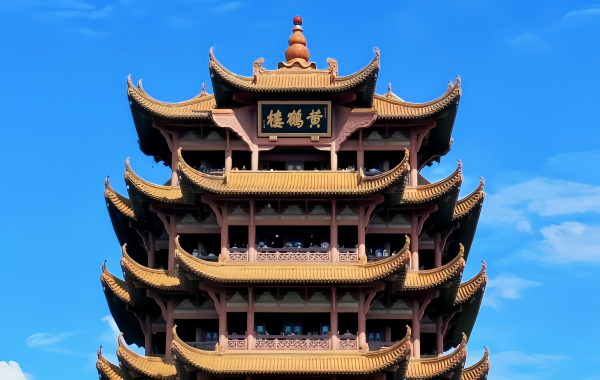
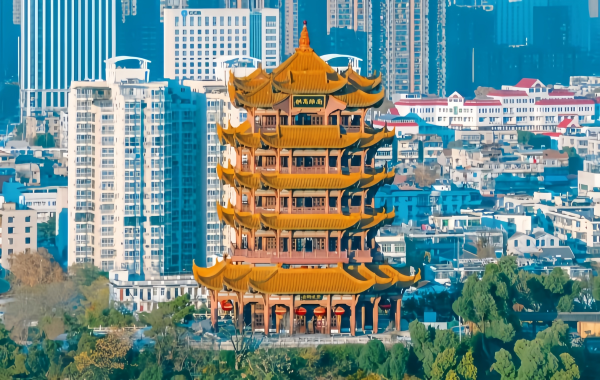
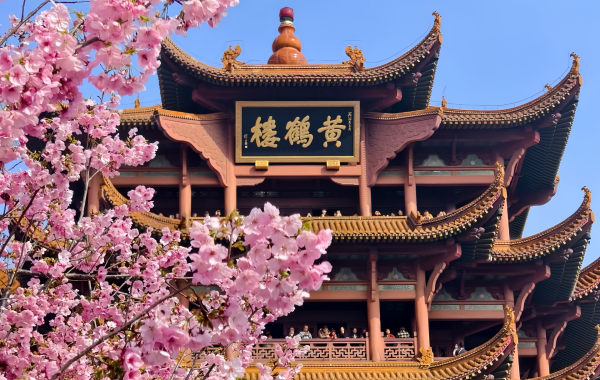
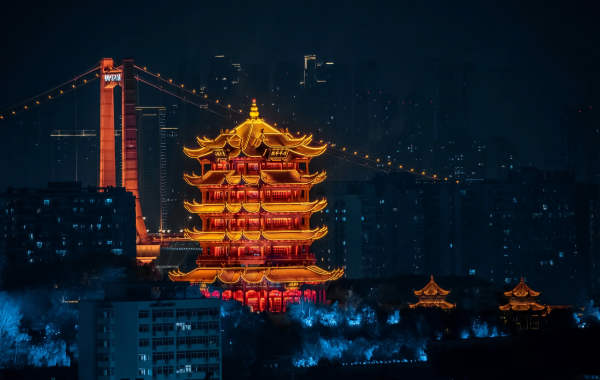
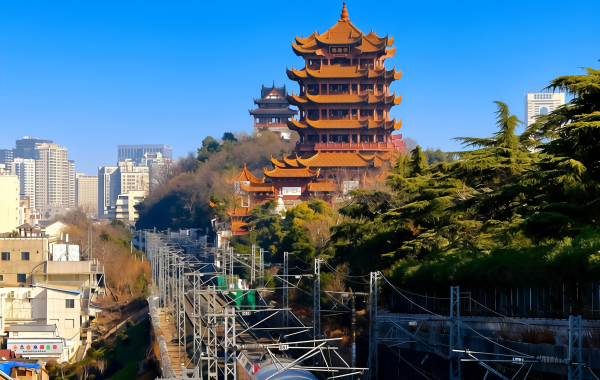
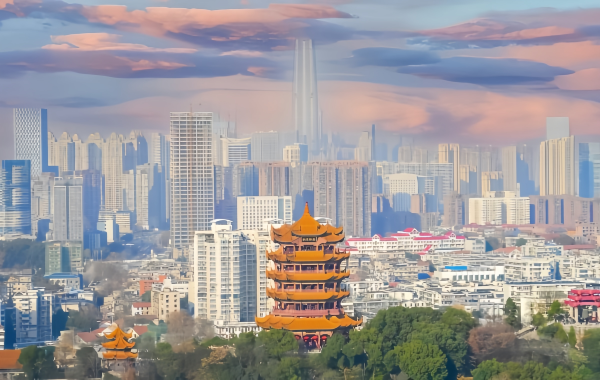
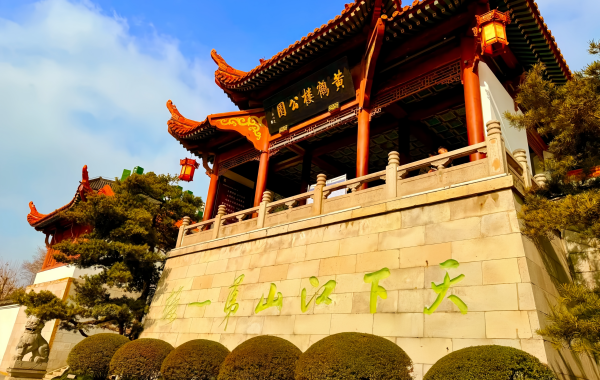
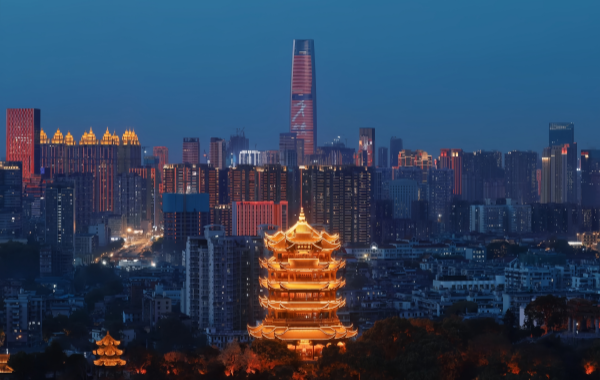
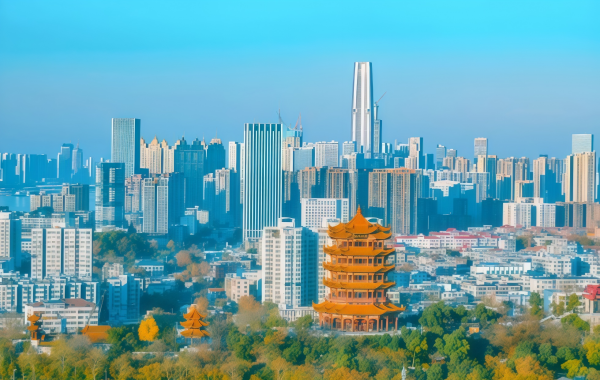
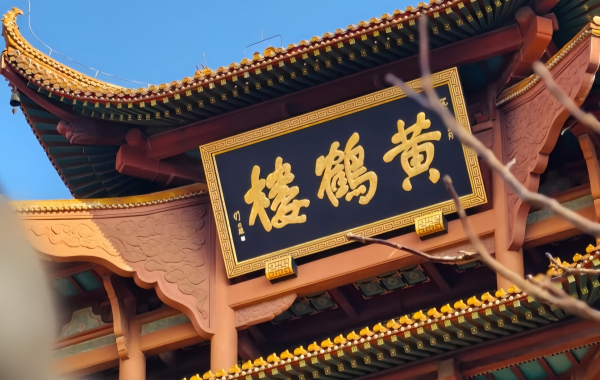
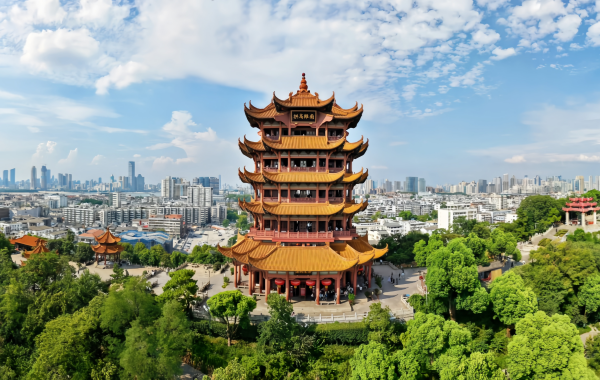
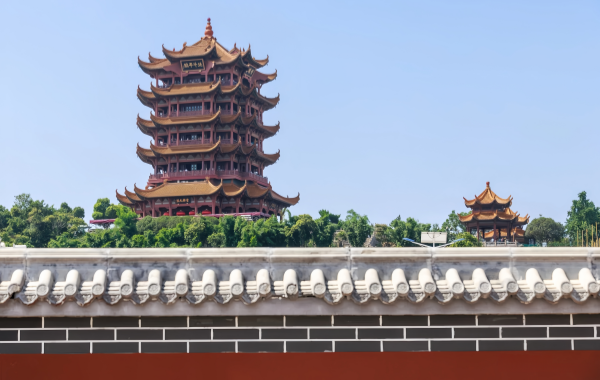
The majestic main building:Today's Yellow Crane Tower is designed based on the Qing Dynasty's"Tongzhi Tower,"perched atop Snake Mountain at an altitude of 61.7 meters,with the Beijing-Guangzhou Railway passing through it.It features five stories with upturned eaves,a pyramidal roof,and a golden glazed tile roof.The tower stands 51.4 meters tall,with a base width of 30 meters and a top width of 18 meters.While it appears to have five stories from the outside,it actually has ten stories inside.The entire building is supported by 72 pillars,with upturned eaves adorned with fish-tail decorations on the roof ridge and dragon-head decorations on the corner beams,each with a copper bell hanging from its front,tinkling in the wind.The building is a reinforced concrete structure imitating wood,exuding a majestic and elegant aura.Each floor inside is decorated with large murals,couplets,and cultural relics.The murals on the second floor depict the evolution of the Yellow Crane Tower's form throughout history,while the third floor presents poetic paintings by famous figures from the Tang and Song dynasties.Climbing from the ground floor to the top,each level offers panoramic views of the magnificent cityscape.The best time to ascend the tower is on a clear afternoon when visibility is high,offering views of the Yangtze River Bridge,Qingchuan Pavilion,Guishan TV Tower,and the skyline of Wuhan's three towns.
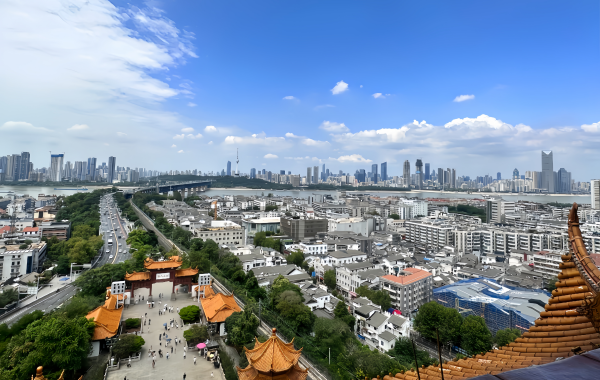
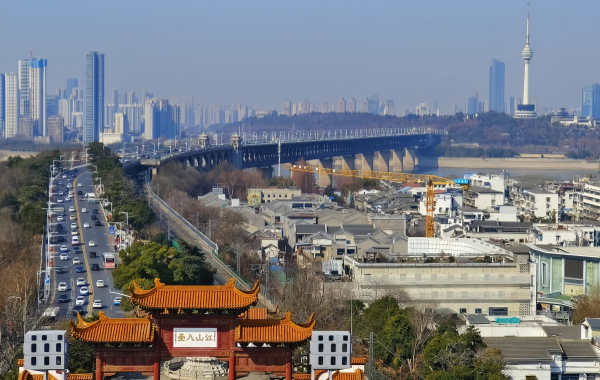
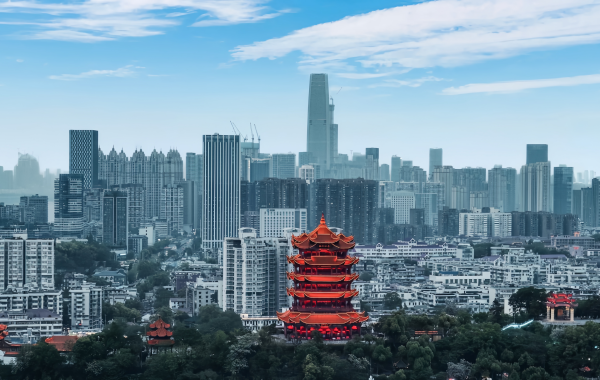
Top Floor Panorama:The fifth floor is the highest observation point in the entire Yellow Crane Tower.From here,the Yangtze River meanders eastward like a ribbon,the Wuhan Yangtze River Bridge spans the two banks,and Guishan TV Tower and Qingchuan Pavilion face each other across the river,the water and sky merging into one.This is the only vantage point for capturing a panoramic view of the city.On a clear day,the shimmering waters of East Lake can also be seen in the distance.Photography Tips:Use a wide-angle lens to capture a broader view of the river and the blending of people and scenery;ascend to the top floor an hour before sunset for the softest light.
Architectural Highlights:The Yellow Crane Tower boasts 48 towering pillars,72 flowing flower-shaped ridges,and 360 bracket sets.Atop the tower stands a copper roof over 3 meters high,1.8 meters in diameter at the base,and weighing approximately 2 tons.Breaking with the construction conventions of previous Yellow Crane Towers,this roof showcases the unique style of the Tongzhi-era tower.The copper roof was crafted by the Zhou Tianshun foundry,a family-run workshop in Wuchang with over 200 years of casting experience.Legend has it that gold ingots were added on the day of casting for good luck.
Photography Tips:
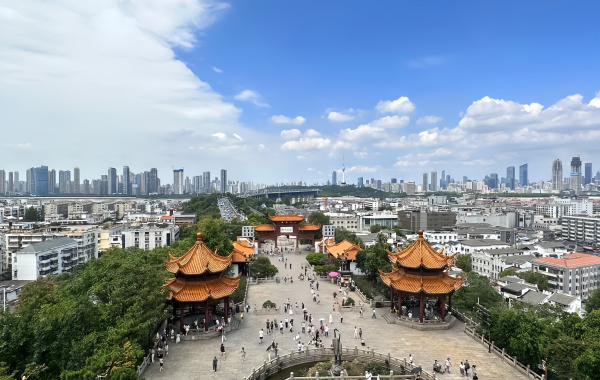
The West Gate Archway is the first sight upon entering,magnificent and perfect for commemorative photos;Baiyun Pavilion offers the best panoramic view of the Yellow Crane Tower,capturing the main building alongside the greenery of Snake Hill;the red-walled alley of Desheng Bridge and the approach to the Yangtze River Bridge are popular photo spots,offering unique perspectives of the Yellow Crane Tower blending with the city's vibrant atmosphere;the fifth floor is the only vantage point offering a panoramic view of the Yangtze River Bridge and the skyline of the three towns,a wide-angle lens is recommended.
Humanistic Craftsmanship–A Spiritual Temple for Nine Hundred Poets
The humanistic value of the Yellow Crane Tower far exceeds its architecture.It is named after poetry,and its soul is imbued by poetry.The profound heritage of the"First Poetry Tower of China":Throughout history,over 900 great poets,including Cui Hao,Li Bai,Bai Juyi,Wang Wei,Meng Haoran,Su Shi,Lu You,Yue Fei,and Mao Zedong,have left behind nearly 1,500 poems and lyrics for it.Cui Hao's poem"Yellow Crane Tower"—"The ancients have ridden the yellow crane away,leaving only this empty Yellow Crane Tower.The yellow crane is gone,never to return,while white clouds drift aimlessly for a thousand years"—is hailed as the masterpiece of Tang Dynasty seven-character regulated verse.Legend has it that the great poet Li Bai,upon seeing this poem after ascending the tower,was deeply impressed,exclaiming,"The scene before me is indescribable,for Cui Hao's poem is inscribed above,"and then laid down his brush and left.Afterwards,Li Bai wrote several famous poems,including"Farewell to Meng Haoran at Yellow Crane Tower"and"Listening to the Flute on Yellow Crane Tower with Shi Langzhong Qin,"adding the timeless lines"My old friend bids farewell to Yellow Crane Tower,heading down to Yangzhou in the misty,flowery third month"and"A jade flute is played in Yellow Crane Tower,plum blossoms fall in the river city in May."
The Cui Hao Poem Relief and the Resting-the-Pen Pavilion:Located in the southern area,the"Cui Hao Poem Relief"is a massive stone sculpture depicting Cui Hao composing a poem on the tower,its grandeur impressive.Next to it is the Resting-the-Pen Pavilion,named after the famous anecdote of"Cui Hao inscribing a poem,Li Bai resting his pen."Inside the pavilion,one can feel the great poet Li Bai's sincere admiration and mutual respect for Cui Hao.
Mao Zedong Poem Pavilion:Located southeast of the South Tower,a large 3.2-meter-high and 1.8-meter-wide bluestone stele stands in the center of the pavilion.The north and south sides are engraved with Mao Zedong's poems"Bodhisattva Man:Yellow Crane Tower,"written during his ascent of Snake Hill in the spring of 1927,and"Water Melody:Swimming,"written after his swim in the Yangtze River in 1956.The powerful lines"Misty rain,vast and boundless,the tortoise and snake lock the great river,"and the ambitious vision of"A bridge spans north and south,turning a natural barrier into a thoroughfare,"allow the poetic spirit of the great man to converge with the timeless tower.
Yue Fei Square:The national hero Yue Fei once stationed troops in Wuhan and wrote"Man Jiang Hong:Feelings Upon Climbing the Yellow Crane Tower"upon ascending the tower.The square features a bronze sculpture of Yue Fei and a stone inscription of"Return My Rivers and Mountains,"allowing visitors to experience the patriotic sentiments of war while enjoying the scenery.
Baiyun Pavilion:Located atop Gaoguan Mountain on Snake Hill,approximately 274 meters east of the Yellow Crane Tower,at an altitude of 75.5 meters and a height of 41.7 meters,it offers an excellent viewing platform for the Yellow Crane Tower,Snake Hill,and the Yangtze River.The pavilion's name originates from Cui Hao's poem,"The Yellow Crane has flown away,never to return;white clouds drift aimlessly for a thousand years."From Baiyun Pavilion,one can capture a classic panoramic view of the main Yellow Crane Tower.
Luomei Pavilion and Bianzhong Music and Dance:The pavilion's name is taken from Li Bai's famous line,"In the Yellow Crane Tower,a jade flute is played;in the fifth month of the river city,plum blossoms fall."The pavilion houses a performance area for a Bianzhong(chime bell)ensemble.Daily performances include court music and dance,Bianzhong songs,and instrumental ensembles.Visitors can enjoy the large-scale ancient court song and dance show"Crane Dance in Chu,"with multiple performances daily(specific times are announced by the scenic area),allowing visitors to travel back a thousand years and experience the elegance of the Chu culture.
Shengxiang Pagoda and Millennium Auspicious Bell:The Shengxiang Pagoda,a Yuan Dynasty building,is one of the oldest existing cultural relics of the Yellow Crane Tower.The Millennium Auspicious Bell,weighing 20 tons,symbolizes the connection between the 20th and 21st centuries.Containing 2.1 kg of gold and 8.4 kg of silver,it is the largest bronze bell cast in my country since the Yongle Bell of the Ming Dynasty.A daily"Bell-Striking Blessing Ceremony"is held,allowing visitors to participate in the ceremony and immerse themselves in Chinese ritual and music culture.
The Yellow Crane Tower Cultural Exhibition Hall(newly opened in 2025):Located at the East Gate Visitor Service Center,this 1700-square-meter hall is themed"The Return of the Yellow Crane."It features a"Preface Hall+Four Exhibition Areas,"providing a panoramic view of the Yellow Crane Tower's legendary history from historical,cultural,construction,and public park perspectives.The hall includes a poetry corridor showcasing traditional calligraphy alongside multimedia;a three-screen,multi-scene theater offers an immersive experience;and visitors can touch 360-degree rotating"electronic versions"of the Yellow Crane Tower from the Song and Qing dynasties,and experience an AI-powered poetry-writing interactive screen.Various old and new items,such as past tickets,stamps,New Year paintings,and laser-cut miniature Yellow Crane Towers,encapsulate the progress and development of the times.The exhibition hall is open to visitors free of charge,offering four free guided tours daily.